September 2026 Edition
AI Sovereignty for SMEs: Where Should Your AI Run?
Why AI Sovereignty Matters
AI sovereignty sounds like a strategic topic for governments and large corporations, but it is becoming a very practical question for SMEs. Where your AI runs affects cost, availability, performance, data protection, trade secrets, vendor dependence, and how easily you can change technology later.
Europe is also putting more emphasis on technological sovereignty in AI, cloud, semiconductors, and open source. For an SME, however, sovereignty does not mean avoiding every non-European component. It means understanding which parts of your AI stack you control - and choosing the level of control that matches the sensitivity and importance of the use case.
Sovereignty is more than server location
- Data & trade secrets
- Where do prompts, documents, logs, embeddings, and model outputs go - and who can technically access them?
- Legal jurisdiction
- Which company is your contractual provider, which laws can apply to it, and are international data transfers involved?
- Operational control
- Can you keep working if the internet, an API, a provider, or a specific model becomes unavailable?
- Technology & lock-in
- Can you move your models, data, APIs, and workflows elsewhere without rebuilding everything?
- Economics & skills
- Do you prefer capital expenditure and in-house operation, or variable cloud cost and managed services?
Even local AI still depends on global hardware, software, models, and supply chains. The goal is not absolute independence, but deliberate control of the dependencies that matter.
From Your Laptop to the Global Cloud
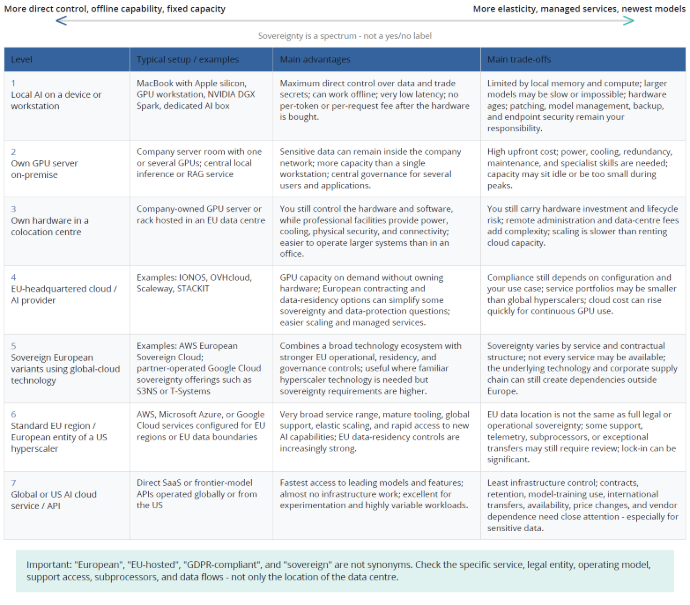
There is no single "sovereign" deployment model. The following spectrum shows seven common ways an SME can run AI - from fully local inference to globally operated AI services - and the main trade-offs at each level.
Seven Deployment Levels - Main Advantages and Trade-offs
The levels below are not a compliance ranking. They show how operational control, elasticity, legal exposure, cost structure, and technical dependence typically change as more of the stack is operated by an external provider.
What Changes as You Move Through the Stack?
Moving from level 1 toward level 7 usually increases elasticity, managed services, and access to the newest models. Moving in the other direction usually increases direct control, offline capability, and independence from an external service. Neither direction is automatically better: the right architecture depends on what the AI is doing and what would happen if data leaked, the provider changed its terms, or the service became unavailable.
One important nuance: even a fully local setup is not completely "European" or independent. GPUs, CPUs, firmware, operating systems, model weights, and software libraries are part of global supply chains. Sovereignty is therefore a gradient - and good architecture makes the dependencies visible rather than pretending they do not exist.
Hybrid Is Often the Practical Answer
For many SMEs, the practical answer is a hybrid architecture. Sensitive documents, embeddings, trade secrets, or a company knowledge base can stay locally or on a controlled European infrastructure, while large cloud models are used only for tasks that do not require the most sensitive information.
A simple routing rule can already help: public or low-sensitivity tasks may use a flexible cloud service; confidential tasks may go to an EU-controlled environment; highly sensitive workloads may stay on-premise. Using standard APIs and portable model formats can also make it easier to change providers later.
Seven Questions to Ask Before Choosing a Provider
1. Where are prompts, uploaded files, logs, embeddings, and outputs stored and processed?
2. Which legal entity signs the contract, and which parent company or non-EU law may still be relevant?
3. Can provider staff or subprocessors access the data, and from which countries?
4. Is customer data used to train or improve shared models, and can this be disabled contractually?
5. Can the model or workload run elsewhere later, or is it tied to proprietary APIs, databases, or orchestration?
6. What are the real costs at steady load: hardware, electricity, administration, GPU hours, tokens, storage, and data transfer?
7. What is the fallback if the model, API, internet connection, or provider is unavailable?
Regulatory reality check
Local hosting does not automatically make an AI use GDPR- or AI-Act-compliant, and using a US provider does not automatically make it unlawful. The relevant questions still depend on the data, the purpose, your role, the risk category, the contract, and any international transfer mechanism. For transfers to certified US organisations, the EU-US Data Privacy Framework is one possible transfer mechanism; other safeguards may also be relevant.
Also worth watching: the EU Data Act
Vendor lock-in is also a regulatory topic. The EU Data Act already contains cloud-switching and interoperability rules. Switching charges - including relevant data-egress charges - are due to disappear from 12 January 2027. That does not make every workload portable, but it makes exit planning an increasingly reasonable procurement requirement.
Looking Forward
A useful sovereignty strategy does not start with the question "cloud or no cloud?" It starts with a map of data sensitivity, required model capability, uptime, cost, and acceptable dependencies. Once those are clear, SMEs can deliberately choose local, on-premise, European cloud, global cloud - or a combination of them.
Content provided by the Machine Learning Group at RPTU for the Boost AI Monthly Background Newsletter series, September 2026 edition.
Steffen Reithermann <https://steffen.reithermann@cs.rptu.de> - https://ml.cs.rptu.de/
Newsletter archive: https://ml.cs.rptu.de/projects/Boost-AI/newsletter/
